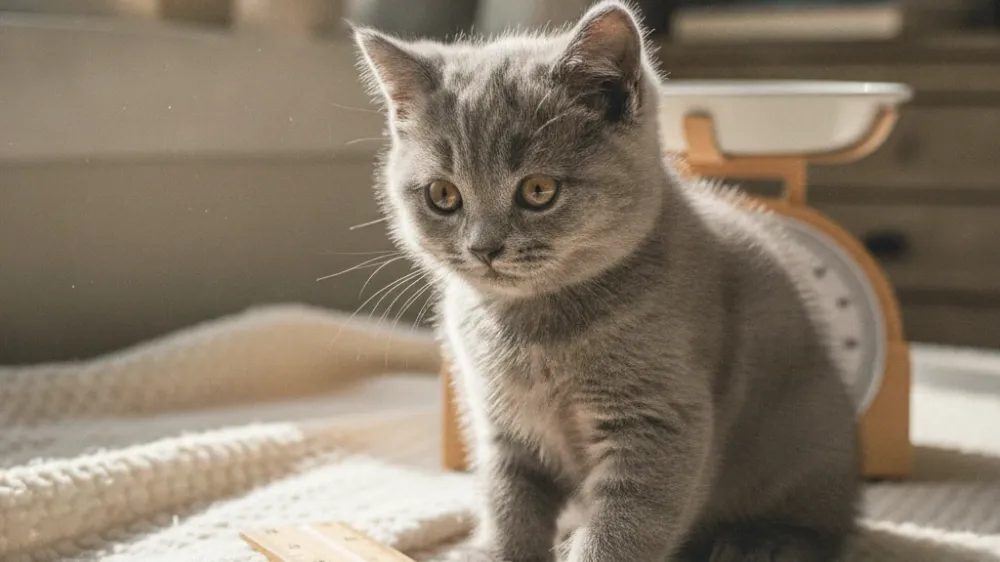
British Shorthairs are famous for their round teddy-bear cheeks, dense plush double coats, and calm, dignified temperaments. Often described as having a “cobby” build, British Shorthairs possess a sturdy, compact, and heavy-boned body supported by thick, strong legs.
Because they are a slow-maturing breed that takes three full years to reach their signature broad chest and round facial structure, tracking monthly weight milestones helps ensure healthy development without excess fat buildup.
💡 Development Note: For general week-by-week weight targets during early kitten development, compare your milestones with our normal kitten weight gain by week guide.
📋 In This Guide
British Shorthair Weight Chart by Month#
Quick Answer: Healthy adult British Shorthair cats typically reach full physical maturity between 3 years, with an overall adult weight range of 9.0 - 18.0+ lbs (4.1 - 8.2+ kg). Adult males average 13.0 - 18.0+ lbs (5.9 - 8.2+ kg), while adult females are slightly lighter at 9.0 - 13.0 lbs (4.1 - 5.9 kg).
Below is a month-by-month guide for male and female British Shorthair kittens from weaning through full adult maturity.
| Age | Male Weight Range | Female Weight Range | Physical & Developmental Milestones |
|---|---|---|---|
| 8 Weeks (2 Months) | 2.0 - 2.8 lbs (0.9 - 1.3 kg) | 1.8 - 2.4 lbs (0.8 - 1.1 kg) | Chubby, compact frame; soft kitten coat |
| 12 Weeks (3 Months) | 3.2 - 4.6 lbs (1.5 - 2.1 kg) | 2.8 - 3.8 lbs (1.3 - 1.7 kg) | Eye color transitions from blue to warm amber/copper |
| 16 Weeks (4 Months) | 4.5 - 6.2 lbs (2.0 - 2.8 kg) | 3.8 - 5.0 lbs (1.7 - 2.3 kg) | Bone density increases; thick paws and sturdy legs |
| 6 Months | 6.5 - 8.8 lbs (2.9 - 4.0 kg) | 5.5 - 7.2 lbs (2.5 - 3.3 kg) | Coat develops signature crisp, dense plush texture |
| 9 Months | 8.5 - 11.5 lbs (3.9 - 5.2 kg) | 7.0 - 9.0 lbs (3.2 - 4.1 kg) | Frame widens; adolescent growth spurt stabilizes |
| 12 Months (1 Year) | 10.5 - 14.0 lbs (4.8 - 6.4 kg) | 8.0 - 10.5 lbs (3.6 - 4.8 kg) | Baseline adult length set; chest broadens |
| 2 Years | 12.0 - 16.5 lbs (5.4 - 7.5 kg) | 8.5 - 12.0 lbs (3.9 - 5.4 kg) | Prominent jowls (cheeks) develop, especially in males |
| 3 Years (Full Adult) | 13.0 - 18.0+ lbs (5.9 - 8.2+ kg) | 9.0 - 13.0 lbs (4.1 - 5.9 kg) | Maximum muscle mass and iconic round silhouette |
The “Cobby” Build: Muscle vs Overweight#
British Shorthairs naturally have a heavy, compact, and round silhouette. However, because they are relatively calm and low-energy indoor cats, it is easy to mistake excess body fat for normal breed stockiness.
How to Check Healthy Body Condition:#
- Rib Check: You should be able to feel their ribs under a light layer of flesh with gentle fingertip pressure. If you have to press firmly to locate ribs, your cat is carrying excess weight.
- Top-Down Profile: Even with their broad chest, there should still be a slight narrowing at the waistline behind the ribcage.
- Activity Level: A healthy British Shorthair is calm but still shows playful bursts of energy during daily interactive play sessions.
Nutritional Priorities for British Shorthair Kittens#
- Calorie-Controlled High-Quality Protein: Feed premium kitten food rich in animal protein with moderate fat levels to build sturdy muscle without excess abdominal fat.
- Portion Control: Avoid free-feeding large dry kibble bowls once your kitten passes 6 months. Measure daily portions to maintain optimal growth velocity.
- Support Joint Health: Because British Shorthairs carry significant weight on compact frames, look for formulas containing omega-3 fatty acids (EPA and DHA) to nourish growing joints and support their dense plush coat.