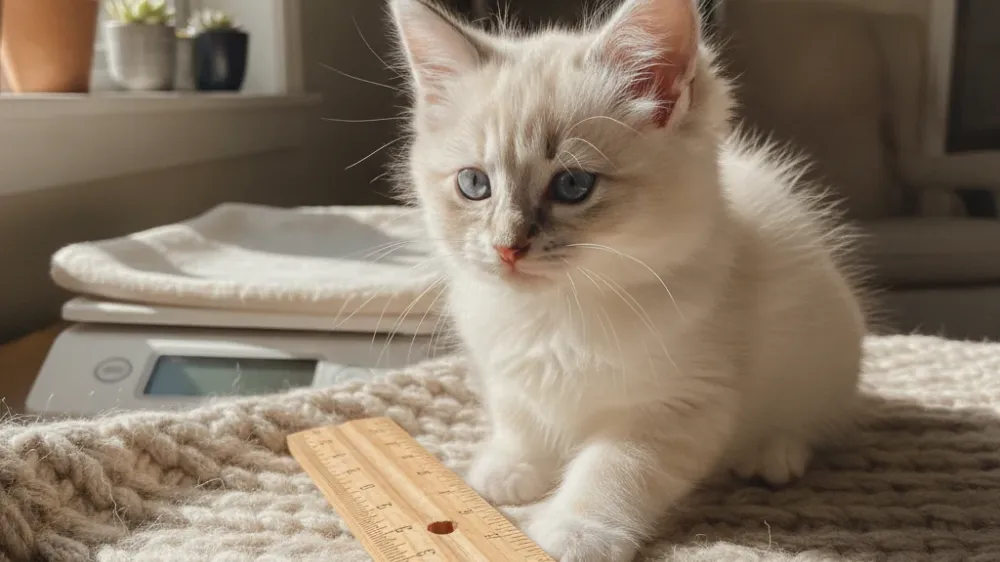
Ragdolls are cherished worldwide for their sapphire-blue eyes, semi-long plush rabbit-like coats, and famously relaxed personalities. Just like Maine Coons, Ragdolls are a large, slow-maturing breed that takes three to four full years to reach their final adult weight and coat coloration.
Whether you just welcomed a seal point, blue point, or bicolour Ragdoll kitten into your home, tracking their month-by-month growth ensures they are developing on a healthy, balanced trajectory.
💡 Development Note: For general week-by-week weight targets during early kitten development, compare your milestones with our normal kitten weight gain by week guide.
📋 In This Guide
Ragdoll Kitten Weight Chart by Month#
Quick Answer: Healthy adult Ragdoll cats typically reach full physical maturity between 3 and 4 years, with an overall adult weight range of 10.0 - 20.0+ lbs (4.5 - 9.1+ kg). Adult males average 15.0 - 20.0+ lbs (6.8 - 9.1+ kg), while adult females are slightly lighter at 10.0 - 15.0 lbs (4.5 - 6.8 kg).
Here is the standard growth roadmap for male and female Ragdoll kittens from 8 weeks through full physical maturity.
| Age | Male Weight Range | Female Weight Range | Physical & Coat Milestones |
|---|---|---|---|
| 8 Weeks (2 Months) | 2.0 - 3.0 lbs (0.9 - 1.4 kg) | 1.8 - 2.6 lbs (0.8 - 1.2 kg) | Points on ears and nose begin showing faint colour |
| 12 Weeks (3 Months) | 3.5 - 5.0 lbs (1.6 - 2.3 kg) | 3.0 - 4.2 lbs (1.4 - 1.9 kg) | Rapid bone lengthening; playful curiosity increases |
| 16 Weeks (4 Months) | 4.8 - 6.8 lbs (2.2 - 3.1 kg) | 4.0 - 5.5 lbs (1.8 - 2.5 kg) | Secondary teeth erupt; soft plush coat thickens |
| 6 Months | 7.0 - 9.5 lbs (3.2 - 4.3 kg) | 5.8 - 7.5 lbs (2.6 - 3.4 kg) | Neck ruff begins forming; body frame broadens |
| 9 Months | 9.5 - 13.0 lbs (4.3 - 5.9 kg) | 7.5 - 9.8 lbs (3.4 - 4.4 kg) | Adolescent growth spurt; coat colour darkens noticeably |
| 12 Months (1 Year) | 11.5 - 15.0 lbs (5.2 - 6.8 kg) | 8.5 - 11.5 lbs (3.9 - 5.2 kg) | Baseline adult skeletal size reached; muscle mass fills out |
| 2 Years | 13.5 - 17.5 lbs (6.1 - 7.9 kg) | 9.5 - 13.0 lbs (4.3 - 5.9 kg) | Chest widens; body fat pad under belly develops naturally |
| 3 - 4 Years (Full Adult) | 15.0 - 20.0+ lbs (6.8 - 9.1+ kg) | 10.0 - 15.0 lbs (4.5 - 6.8 kg) | Full adult coat density, deepest eye colour, and final weight |
Ragdoll Color Development Alongside Physical Growth#
One of the most fascinating aspects of raising a Ragdoll kitten is watching their coat transformation:
- Born Pure White: All purebred Ragdoll kittens are born completely white due to a temperature-sensitive enzyme that regulates pigment production.
- Weeks 2 to 8: The coolest parts of their body (ears, nose, tail, and paw pads) begin producing dark melanin, revealing whether your kitten is seal, blue, chocolate, lilac, or flame.
- Months 6 to 24: The body coat takes on subtle cream or beige shading while the points deepen into their rich signature shade.
- Year 3: The final, rich contrast between the body coat and dark points is fully set.
Key Nutritional Guidelines for Growing Ragdolls#
1. High-Protein, Nutrient-Dense Diets#
Because Ragdolls develop heavy bone density over several years, prioritize kitten formulas rich in animal-sourced proteins (such as chicken, turkey, and salmon) with balanced calcium-to-phosphorus ratios.
2. Moisture is Critical#
Ragdolls are notorious for low thirst drives. Incorporating wet canned food into daily meals provides essential hydration that supports urinary tract health throughout their development.
3. Monitoring the Primordial Pouch#
Ragdolls naturally have a soft, fatty pouch on their lower abdomen called the primordial pouch. This is a normal breed trait that protects vital organs and allows full running extension. To ensure your cat is at a healthy weight, assess the firmness over the ribs rather than judging purely by the abdominal pouch.
Home Setup for a Thriving Ragdoll Kitten#
- Cozy Ground-Level Rest Spots: Ragdolls are known as “floor cats” rather than high-flying acrobats. They prefer plush cat beds, window perches, and low platforms over towering vertical trees.
- Keep Indoors Only: Due to their trusting, non-defensive nature, Ragdolls lack street survival instincts and should always be kept as indoor companion cats.
- Daily 5-Minute Combing: A stainless-steel comb keeps their silky coat free of minor tangles while reinforcing their bonded affection.