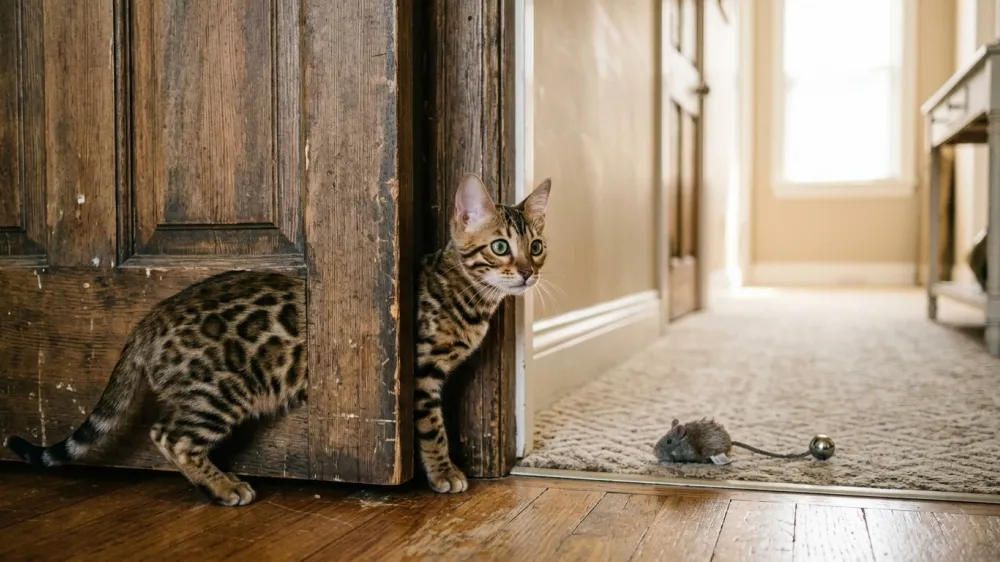
Bengal cats are widely loved for their vivid leopard-like rosettes, muscular builds, and playful personalities. Because the breed originated from crosses between domestic felines and wild Asian Leopard Cats (ALCs), prospective owners frequently ask whether Bengal cats are legal to keep as house pets.
While the vast majority of Bengals living in family homes are fully legal domestic companions, key exceptions exist across specific states, municipalities, and rental communities. Understanding filial generations, city codes, and required documentation prevents unexpected legal hurdles.
To see how Bengal regulations compare with other hybrid breeds, review our complete overview on banned cat breeds in the US.
📋 In This Guide
1. Domestic Bengals vs. Early Generation Hybrids#
The legal status of a Bengal depends heavily on its filial generation ($F1$ through $F5+$):
- Foundation Generations (F1 to F3): These cats have an Asian Leopard Cat as a parent, grandparent, or great-grandparent. They retain significant wild instincts, can be skittish around strangers, and are classified as exotic wildlife in many jurisdictions.
- Domestic Bengals (F4, F5, and SBT): SBT stands for Stud Book Traditional. An SBT Bengal is at least four generations removed from the wild ancestor, bred only to other domestic Bengals for at least three generations. Major cat registries like The International Cat Association (TICA) and the Cat Fanciers’ Association (CFA) recognize SBT Bengals as fully domestic pets.
Reputable hobby breeders almost exclusively sell SBT Bengals to pet homes. When purchasing a kitten, verify that your contract and pedigree certificate confirm SBT status.
To track your kitten’s growth timeline from adoption through adulthood, reference our Bengal cat growth and weight chart.
2. States with Strict Bengal Restrictions#
Most US states recognize SBT Bengals as standard domestic cats that require no special permits. However, certain states enforce strict bans or permit rules:
Hawaii#
Hawaii prohibits all Bengal cats, regardless of generation. Due to the island’s isolated ecosystem and vulnerable endemic bird populations, state Department of Agriculture regulations ban the importation and possession of all wild felid hybrids.
New York#
In New York State, domestic Bengals (F4 and later) are legal. However, New York City enforces Health Code Section 161.01, which outlaws all wild feline hybrids across all five boroughs. Possessing a Bengal within NYC limits can result in fines and surrender orders.
Connecticut#
Connecticut restricts early generations (F1 through F4). Only F5 and later generations are legal to own without a state permit.
Delaware#
Delaware requires a state possession permit for F1 through F3 Bengals. F4 and subsequent generations are considered domestic and require no permit.
Alaska#
Alaska permits Bengals only if they are F4 or later and documented with proof of domestic pedigree.
3. Notable City and County Restrictions#
State legality does not guarantee city approval. Several major metropolitan areas enforce distinct municipal codes:
- Seattle, Washington: The Seattle Municipal Code restricts early-generation hybrid cats, requiring domestic certification for SBT Bengals.
- Denver, Colorado: While Colorado allows domestic Bengals, municipal ordinances across the Denver metro area regulate exotic crosses.
- Apartment and HOA Policies: Many apartment communities and condo associations include broad exotic pet bans in lease agreements. Landlords can legally prohibit hybrid breeds even if the city permits them. Always obtain written pet approval before bringing home a kitten.
4. Required Paperwork and Proof of Pedigree#
If you live in or travel through a jurisdiction that distinguishes between wild hybrids and domestic cats, maintaining clear documentation is necessary:
- Certified Pedigree: Official registration papers from TICA, CFA, or ACFA listing at least four generations of pedigree history.
- Breeder Contract: A signed bill of sale explicitly stating the kitten is an SBT domestic Bengal.
- Veterinary Records: Up-to-date rabies vaccination and microchip documentation showing the microchip number registered to your contact details.
5. Daily Enrichment and Care for Bengal Cats#
Because Bengals are exceptionally athletic, providing dedicated outlets for their natural curiosity is key to a harmonious home:
- Vertical Climbing Space: Bengals love surveying territory from high vantage points. Tall, sturdy cat trees keep them engaged and active.
- Active Foraging: Interactive puzzle feeders satisfy their hunting instincts and prevent counter surfing.
- Interactive Toys: Keep their quick minds occupied with stimulating games from our guide on interactive toys for kittens.
- Outdoor Exploration: Many Bengals thoroughly enjoy exploring nature on a secure leash. Learn how to introduce equipment gently with our step-by-step tutorial on how to harness train a kitten.