While traditional domestic cat breeds (such as Persians, Maine Coons, Ragdolls, and Siamese) are 100% legal across all 50 states, the legal landscape shifts dramatically when dealing with wild feline hybrid breeds. Breeds like Savannahs, Bengals, and Chausies carry ancestry from wild exotic felids, subjecting them to strict state wildlife statutes, municipal health codes, and permit mandates.
If you are planning to bring home a hybrid designer kitten, understanding filial generations ($F1$ through $F5+$) and regional laws is critical before signing breeder contracts. In this guide, we break down the legal status of cat breeds across the United States.
📋 In This Guide
1. Filial Generations Explained: F1 vs. F5#
The legality of a hybrid cat almost always hinges on its Filial ($F$) Generation, which measures how many generations removed the cat is from its wild ancestor:
- F1 Generation (50% Wild Ancestor): One wild parent (e.g. African Serval) and one domestic cat parent. These cats are massive, possess high predatory drives, and are legally classified as exotic wildlife in most states.
- F2 Generation (25% to 35% Wild Ancestor): One wild grandparent. Still classified as restricted wildlife in many jurisdictions.
- F3 Generation (12% to 20% Wild Ancestor): One wild great-grandparent. Permitted in some states with containment requirements.
- F4 and F5+ Generations (SBT / Stud Book Traditional): Considered legally domestic in the majority of states, as wild behavioral traits have settled into predictable companion temperaments.
2. State-by-State Breakdown: Banned & Restricted Cat Breeds#
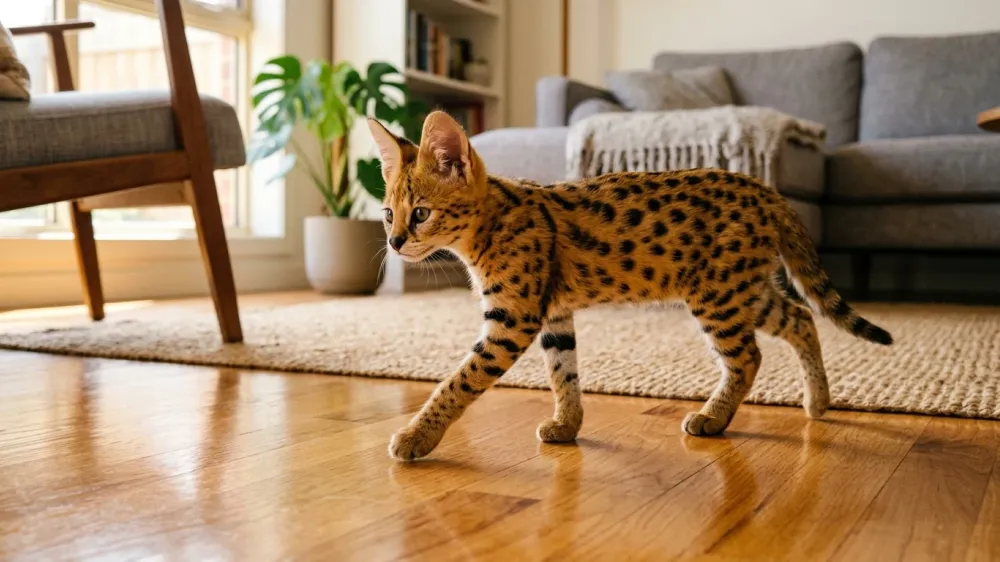
Savannah Cats (Domestic Cat x African Serval)#
The Savannah is the most strictly regulated domestic hybrid in North America due to its immense size, high jumping agility (up to 8 vertical feet), and strong prey drive.
- Banned Completely (All Generations F1-F5+):
- Hawaii: Strict ecosystem and native bird protection laws ban all wild felid hybrids.
- Georgia: Prohibits all crosses of wild felids without a licensed commercial wildlife exhibition permit.
- Massachusetts: Banned without dedicated Department of Fisheries & Wildlife permits.
- Rhode Island: Banned across all generations.
- New York City: NYC Health Code §161.01 explicitly outlaws owning any feline hybrid, regardless of generation.
- Early Generations Banned (F1-F3 Illegal, F4+ Legal):
- New York State (Outside NYC): F4 and later generations are legal without permits.
- Texas: Several major counties (including Dallas and Harris counties) require exotic permits for F1-F3.
- Colorado & Indiana: F1-F3 require registered USDA/State permits.
Bengal Cats (Domestic Cat x Asian Leopard Cat)#
Because the Bengal breed has been established for decades, late generations (F4 and F5+) are recognized as fully domestic by major registries like TICA and CFA. However, specific regions maintain strict bans:
- Hawaii: Banned completely across all generations.
- New York City: Illegal under NYC Health Code §161.01.
- Connecticut: F1 through F4 are prohibited; only F5+ SBT Bengals are permitted.
- Seattle, Washington: F1 through F3 are prohibited within city limits.
Chausie & Safari Cats (Domestic Cat x Jungle Cat / Geoffroy’s Cat)#
- Chausies (Jungle Cat crosses) and Safari Cats (Geoffroy’s Cat crosses) follow identical legal frameworks to Savannahs. They are banned in Hawaii, NYC, and restricted across Massachusetts and Georgia.
Hybrid Cat Legality Matrix#
| Breed | Wild Ancestor | States with Complete Bans | States with Early Generation (F1-F3) Bans |
|---|---|---|---|
| Savannah | African Serval | HI, GA, MA, RI, NYC | NY (outside NYC), TX, CO, IN |
| Bengal | Asian Leopard Cat | HI, NYC | CT (F1-F4 banned), Seattle (F1-F3) |
| Chausie | Jungle Cat (Felis chaus) | HI, GA, MA, NYC | NY, RI, CT |
| Toyger / Ocicat | 100% Domestic (Selective Breeding) | None (Legal in all 50 states) | None (No wild DNA) |
| Pixie-bob | 100% Domestic (Natural Mutation) | None (Legal in all 50 states) | None (No wild DNA) |
3. Structural Designer Cats: Munchkins and Scottish Folds#
Unlike wild hybrids, breeds with unique genetic mutations (such as short-legged Munchkins, folded-ear Scottish Folds, or hairless Sphynx) are 100% legal to own across all 50 US states.
While animal welfare debates exist in certain European countries regarding structural ethics, US federal and state laws treat all non-hybrid designer breeds as standard domestic felines.
Responsible Ownership Guidelines for Exotic & Hybrid Breeds#
If you live in a state where hybrid cats are permitted, providing appropriate care ensures safety and fulfillment:
- Verify Local Municipal Codes: City and county ordinances frequently override state laws. Always call your local animal control department before bringing home an F1-F4 kitten.
- Channel High Predatory Drives: Hybrid and athletic breeds possess immense mental energy. Use interactive foraging tools like the Catit Senses 2.0 Digger Interactive Cat Feeder to channel hunting instincts into positive stimulation.
- Calm New Territory Stress: Transitioning an energetic kitten into a new home can cause vocalization or marking. Setting up a Feliway Optimum Enhanced Calming Diffuser helps reduce baseline stress and territorial anxiety.
- Harness Training for Outdoor Exercise: Never allow hybrid cats to roam freely outdoors. They are apex hunters that can decimate local songbird populations. Review our guide on how to harness train a kitten for safe, leashed outdoor adventures.
- Request Breeder Lineage Certificates: Always insist on official pedigree papers (TICA or CFA) verifying the exact filial generation ($F4$, $F5$, etc.) of your kitten to avoid legal disputes with landlords or municipal authorities.
Start your kitten off right with our comprehensive First Kitten Care Guide and Scratching Post Training Guide.
💡 Related Guide: For municipal codes, permit exemptions, and generation guidelines, review our detailed guide on Bengal cat state and city ownership laws.
💡 Related Guide: For a complete state-by-state permit and legal analysis, read our complete breakdown on whether Savannah cats are legal in all 50 states.